

Menopause stories

It started when I was 21
Gabriella’s first experience happened during pregnancy. She remembers being at her former mother-in-law's house in winter, sitting beside a Rayburn fireplace, but shivering despite the heat. She was wearing a scarf, gloves and a hat because she felt so cold. What she didn't have was pain.
Gabriella had a fever and felt extremely unwell, but had no idea what was wrong. She went to her GP and was told she had a water infection. She was given antibiotics, the symptoms went away, and for around ten years, she experienced nothing similar.
Then, in 1997, it started again.
This time, Gabriella recognised the feeling as pain associated with an infection. At first, the episodes were relatively infrequent. From around 1998 to 2006, she describes experiencing what she understood to be an infection approximately every two years. She would see her doctor, receive antibiotics, and, in her experience, the pain could disappear remarkably quickly.
“Literally within an hour of taking the first tablet, the pain was all gone.”
For a while, that pattern seemed manageable until 2006.
When pain becomes normal
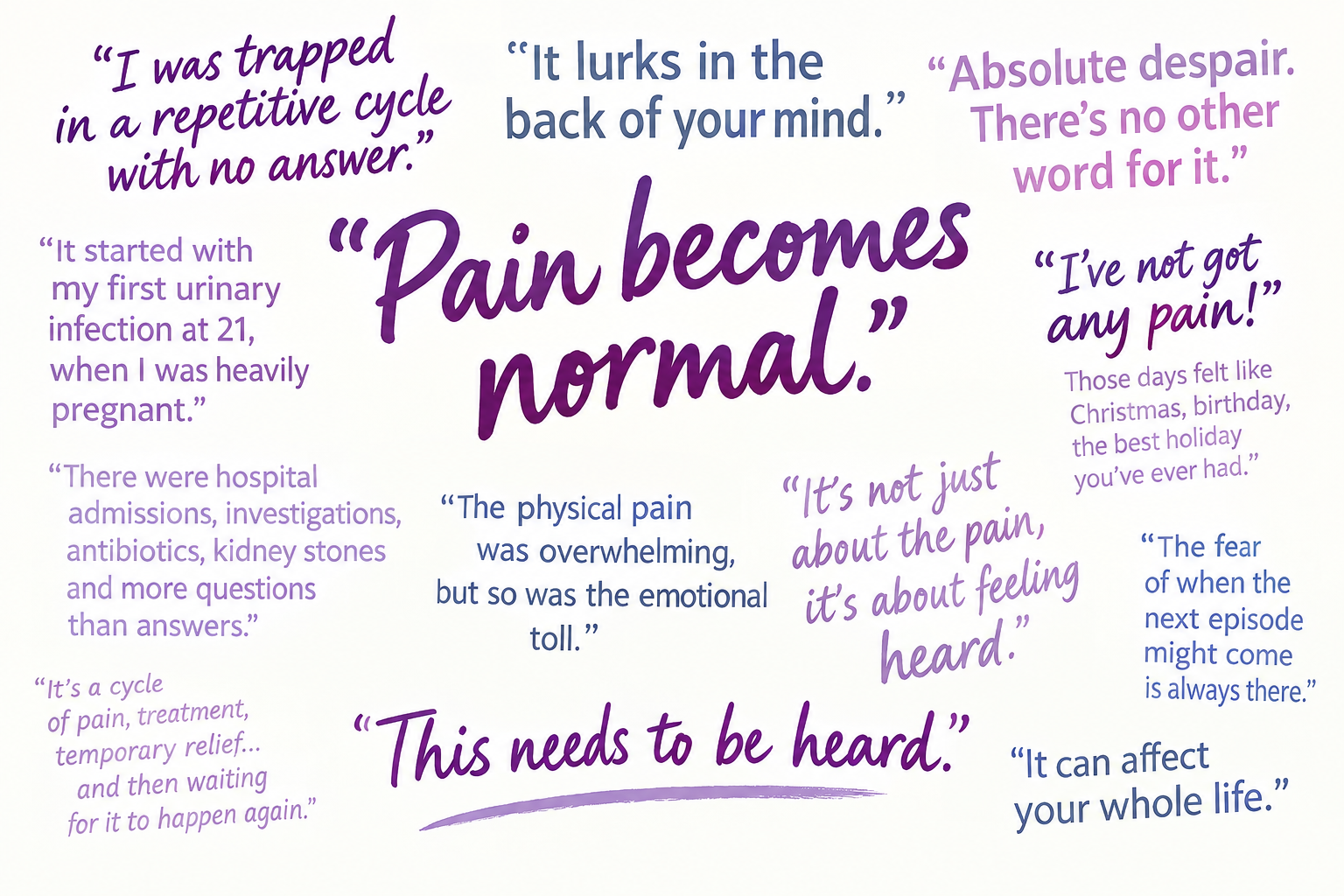
Over many years, something else happened; she became accustomed to living with pain, not the worst pain, not the kind that sent her to the hospital, that often took her to places of deep psychological trauma and fear. But the lower levels, the pain that was always there somewhere in the background. Gabriella explains that when the pain is relatively low, she can continue with everyday life, function to a degree, laugh, make plans and do most of the things she wants to do. However, the pain is still there.
“It lurks in the back of your mind.”
“You fear every twinge, scared that it may escalate into severe pain”
Therefore, because she has lived with it for so long, a lower level of pain can become almost unnoticeable.
“You get so used to pain, you don't; when it's low, you don't even notice you've got it.”
That led to one of the most powerful statements in her story:
“Pain becomes normal.”
It is a simple sentence, but it says a great deal about living with chronic pain. When something is present for long enough, the absence of pain can become unusual. She expressed the occasional times when her pain completely disappears as extraordinary.
“I've not got any pain!”
Those moments could feel like:
“Christmas, birthday, best holiday you've ever had.”
For someone who lives with persistent or recurring pain, a pain-free day is not necessarily an ordinary day; it can feel like getting part of your life back.
2022–2025: living between episodes
Even after the kidney stone was removed, the story did not simply end. Gabriella experienced ongoing episodes which involved hospital visits, investigations and periods of relief followed by another flare. The emotional impact of never knowing when the next episode might happen often led her to despair. There could be weeks or months when things were manageable, followed by a sudden deterioration. In February 2025, she experienced another particularly severe episode wherein she remembers the pain becoming progressively worse, eventually becoming unbearable. An ambulance was called, and she spent the night in A&E.
She describes feeling frightened, alone and desperate for someone to understand how much pain she was in. This is where the emotional side of chronic pain becomes impossible to separate from the physical experience.
Gabriella was not simply dealing with pain; she was dealing with the fear of the pain returning, dealing with previous experiences of being dismissed, and dealing with uncertainty and fear. Alongside trying to work out what to do when something that had happened so many times before started happening again.
February 2026: when the fear comes with the pain
By February 2026, she had lived with this cycle for decades, the knowledge of what an episode could become, how quickly relatively manageable symptoms could escalate and how frightening the hospital experience could be. During another severe episode, she describes experiencing:
“Panic, fear, desperation, flight, escapism, and hopelessness” all at once.
Gabriella became increasingly unwell and eventually went to the hospital. The severity of the episode meant that she required urgent assessment and treatment, being given pain relief after waiting for such a long time. What she remembers most strongly, however, is the moment when the pain finally began to disappear.
“The pain was just going, and I was literally pain-free, and I just wanted to cry.”
After so many years of pain, relief was overwhelming. She describes being pain-free for seven days during a later trip to Cyprus. “Seven days!”
Not “better”.
Not “manageable”.
Not “a little less painful”.
Nothing.
“Not even like low level, nothing. I was pain-free for 7 days. It was wonderful.”
Then Gabriella came home, and the pain returned.
Where does menopause fit into the story?
This is an important part of Gabriella’s experience, but it is also important not to oversimplify it; her urinary and pain problems began long before menopause, having experienced them from her early twenties, decades before she reached menopause.
Gabriella’s story, therefore, does not suggest that menopause caused her condition.
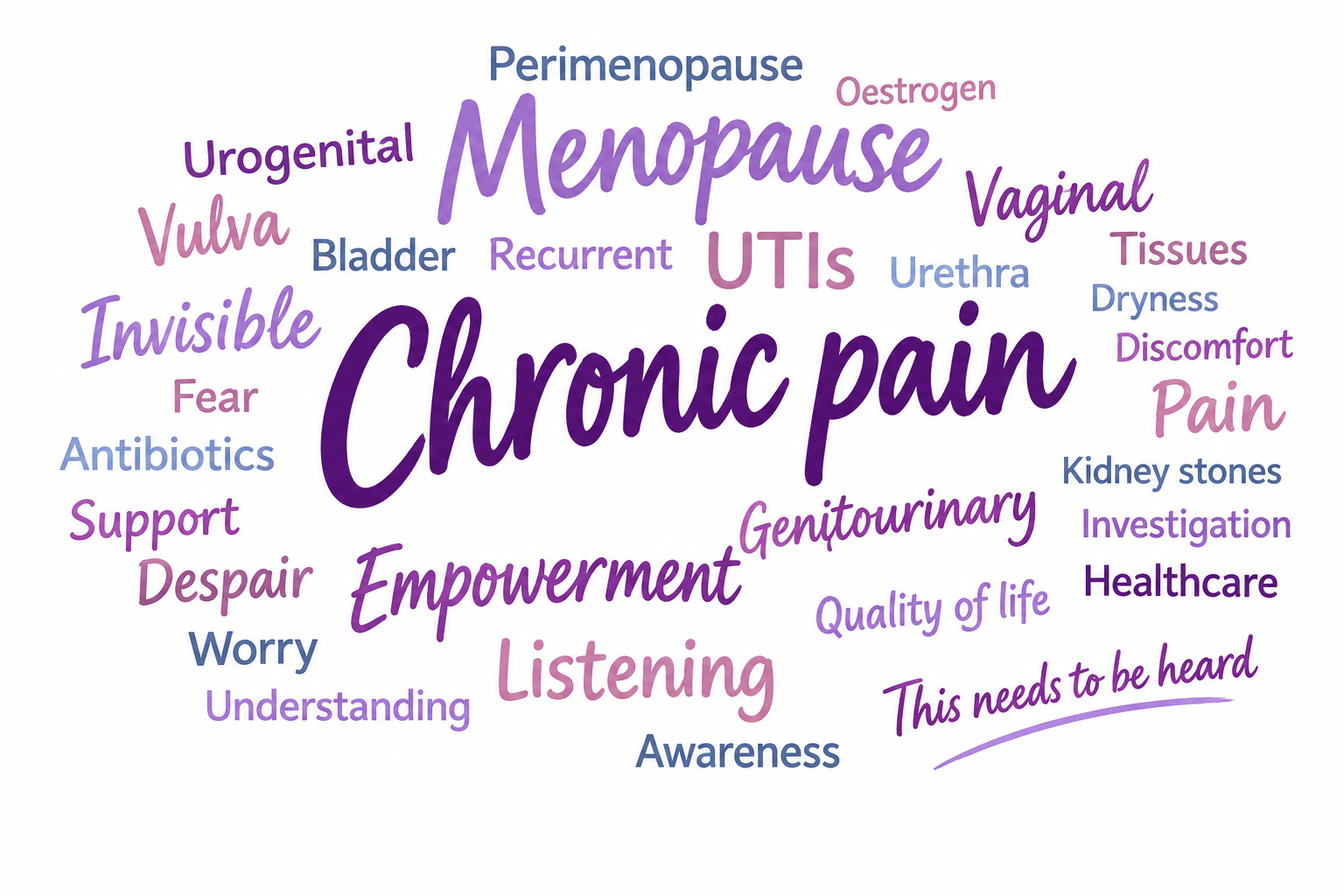
What it does highlight is that the menopause transition can introduce another layer of change to the urinary and genital system, and that this connection is not always discussed in healthcare, in society or even described in everyday language. During perimenopause and menopause, changing and eventually lower oestrogen levels can affect the tissues of the vagina, vulva, urethra and bladder, which can contribute to symptoms including vaginal dryness, irritation, burning, discomfort, urinary urgency and recurrent urinary tract infections. NHS guidance recognises that women may experience more UTIs or UTI-like symptoms around the menopause (NHS, 2026).
These symptoms are often described collectively as genitourinary symptoms of menopause (GSM; Angelou et al., 2020).
NICE (2018) guidance also recognises the connection between menopause, genitourinary symptoms and recurrent UTIs. Vaginal oestrogen can be considered for people experiencing recurrent UTIs during perimenopause or menopause, with treatment decisions made according to individual circumstances and reviewed regularly. This distinction matters:
Not every urinary symptom during perimenopause or menopause is caused by menopause.
Urinary symptoms and pelvic or abdominal pain can have many possible causes. Kidney stones, infections and other conditions can produce symptoms that may overlap. That is one reason stories like this matter. A woman may know that something has changed in her body, while at the same time not knowing why it has changed. Therefore, when several things are happening at once, it can become very difficult to separate one symptom from another.
The menopause connection Gabriella wishes she had known about
Looking back, she believes the menopause transition may have interacted with other conditions affecting her body. She says:
“I know that becoming perimenopausal can exacerbate these conditions, but nobody told me about that.”
Whether or not menopause explains any individual symptom is something that needs to be assessed on an individual basis. However, her wider point is important.
Women need information about the possible changes that can happen to their urinary and genital health during perimenopause and menopause (Comen, 2026).
These are not always the symptoms that make it into everyday conversations about menopause. Hot flushes, periods, sleep and mood may be talked about more openly. However, symptoms such as urinary urgency, recurrent UTIs, vaginal dryness, burning, genital discomfort, and pain can be much harder to talk about.
When symptoms involve intimate parts of the body, women may feel embarrassed, dismissed or uncertain about whether what they are experiencing is “normal”. It shouldn't mean they stop asking questions.
Meet Gabriella - When pain becomes normal
One woman's experience of chronic urinary and urogenital pain, uncertainty, healthcare, and finding a way to keep going.
“Pain becomes normal.”
For many women, pain is something that is expected to pass. For the woman whose story we share here, pain became something she learned to live with. Her experience began more than 40 years ago, with what she describes as her first “water infection” when she was just 21 and heavily pregnant with her first child. What followed was a long and complicated journey of recurring urinary symptoms, severe pain, hospital admissions, investigations, antibiotics, a kidney stone and, at times, the devastating feeling that nobody could explain what was happening to her body.
This is Gabriella’s story, in her own words as far as possible.
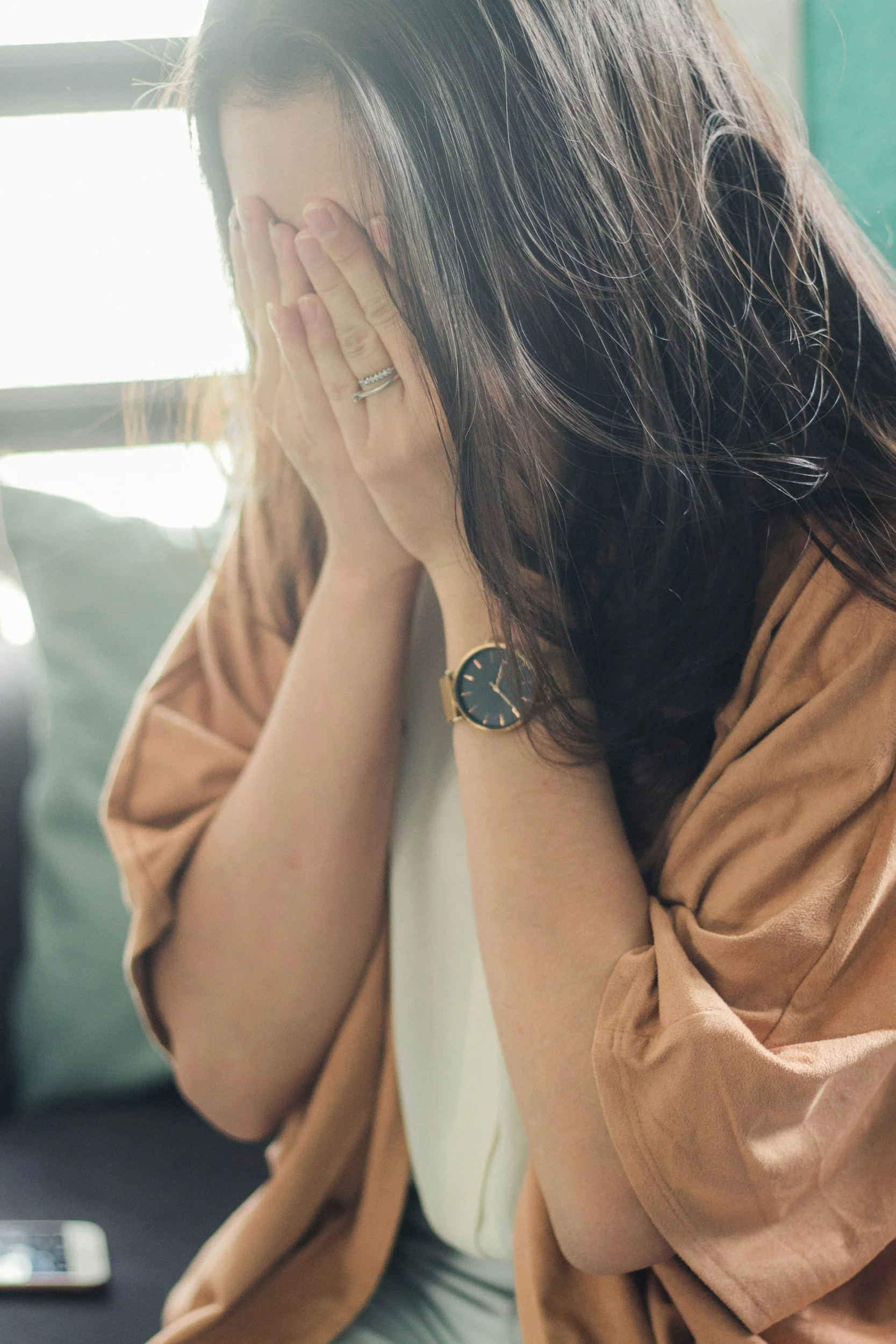
(Photos are stock photos, and not Gabriella.)
In May 2006, everything changed
Another episode began; this time, the antibiotics did not work. What followed was several months of increasingly severe pain. Gabriella describes intense pain in her genital area and recalls the experience as being difficult to put into words. By August, she was taken to A&E and admitted overnight. She remembers being in such severe pain that she was “rolling around the trolley” in agony.
Eventually, stronger and longer-term antibiotics appeared to settle that particular episode. However, something had changed. Gabriella describes 2006 onwards as the point when the condition became much more difficult to deal with, both physically and psychologically. The episodes also became more frequent.
When she started a new job in 2009, she recalls infections occurring anywhere from around six months to 17 months apart. Seventeen months without an episode felt like a significant achievement; six months felt like a very short time. And gradually, she began to realise that treating each individual episode was not the same as understanding why it kept happening.
Searching for answers
Over the years, Gabriella became increasingly knowledgeable about her own symptoms and increasingly frustrated by the lack of clear answers. She describes repeatedly going to healthcare professionals with pain, providing urine samples and being treated for suspected infections.
Sometimes treatment helped, sometimes it didn't.
There were hospital visits and investigations, and periods when she felt she was being passed from one place to another without anyone reaching the bottom of what was happening.
Gabriella expresses it as:
“An endless cycle of it's this, it's that, but never getting to the bottom of why I was and am experiencing all the pain.”
For her, the uncertainty became almost as difficult as the physical symptoms.
“I was trapped in a repetitive cycle with no answer.”
She expressed feeling that healthcare professionals did not always understand the severity of what she was experiencing. When asked how this affected her emotionally, her answer was immediate:
“Absolute despair. There's no other word for it.”
The kidney stone that finally gave an answer
One of the most significant developments came in 2021, after years of believing she was experiencing repeated infections, investigations eventually revealed a kidney stone. Gabriella had been experiencing severe urinary and bladder pain and recalls not initially knowing that a kidney stone could be responsible for symptoms that felt so much like an infection. The stone was a significant size, around 5mm. For Gabriella, discovering it was significant because, finally, there was something visible that could explain at least some of what she had been experiencing.
She remembers having provided a urine sample that was visibly red with blood, describing feeling shocked when she felt that her concern was dismissed, the battle to push to be seen, to advocate for herself when the healthcare professionals seemed not to care. This time, she had insisted on further assessment, leading to a scan identifying the kidney stone.
Attempts were made to break it up, but eventually it had to be surgically removed. The experience reinforced something she had learned repeatedly throughout her journey:
Sometimes there is more than one explanation for pain that feels like a urinary infection.
Her story includes suspected infections, severe urinary symptoms, kidney stone pain and ongoing episodes of pain. It is not a story with one simple diagnosis or one straightforward explanation.
“This can't go on”
By this point, Gabriella had reached a stage where she felt she could no longer continue going around the same cycle. The constant cycle of treatment, relief, another episode, more pain, more uncertainty, then waiting for it to happen again.
Gabriella began looking for specialist private care because, as she put it:
“This can't go on.”
She describes feeling that she was:
“going around in circles”
There had to be some kind of answer, or at least some help. Eventually, she saw a specialist who discussed the pattern of her symptoms with her and provided something that had become incredibly important to her: reassurance, a potential end to the cycle.
“You just need some reassurance, and because you just live in so much trauma.”
That word - trauma - is important.
Because chronic pain is not only about what happens to the body during an episode. It can change the way you anticipate the future. It can make a new sensation frightening because you remember what happened last time, making it difficult to think clearly when pain becomes severe, and the feeling to constantly monitor your own body, which at times can become exhausting. Meaning that even when you are having a relatively good day, part of you is waiting for the next episode.
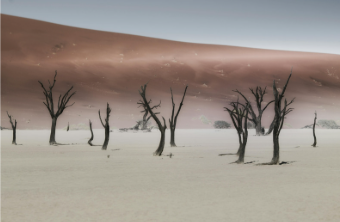
What does chronic pain look like when you can't see it?
One of the most relatable parts of Gabriella’s story is the difference between what other people see and what she experiences. On a relatively good day, she can live a relatively normal life, appearing completely fine. Gabriella may not look like someone who is living with chronic pain; however, the pain is still part of her awareness.
“It lurks in the back of your mind.”
That invisible element can be difficult for other people to understand. A woman can be laughing with friends one day and be in the hospital with unbearable pain another day. Or go to work, go on holiday, make plans and enjoy herself, whilst simultaneously knowing that another episode could happen. This story highlights how learning to live with moderate pain is an experience where you can grow accustomed to the pain. Furthermore, Gabriella also describes what happens when the pain escalates, that the difference is enormous, and that difference is why the phrase “pain becomes normal” is so powerful. Normal does not necessarily mean acceptable; it can simply mean familiar.
Why Gabriella wanted her story heard
Throughout the interview, one message comes through repeatedly and with passion. The desire for people to understand the severity of the pain experienced by women with urinary and urogenital conditions. Not because every woman's experience is the same or because she has all the answers, but rather because Gabriella believes women need to be listened to.
At one point, she says:
“This needs to be heard.”
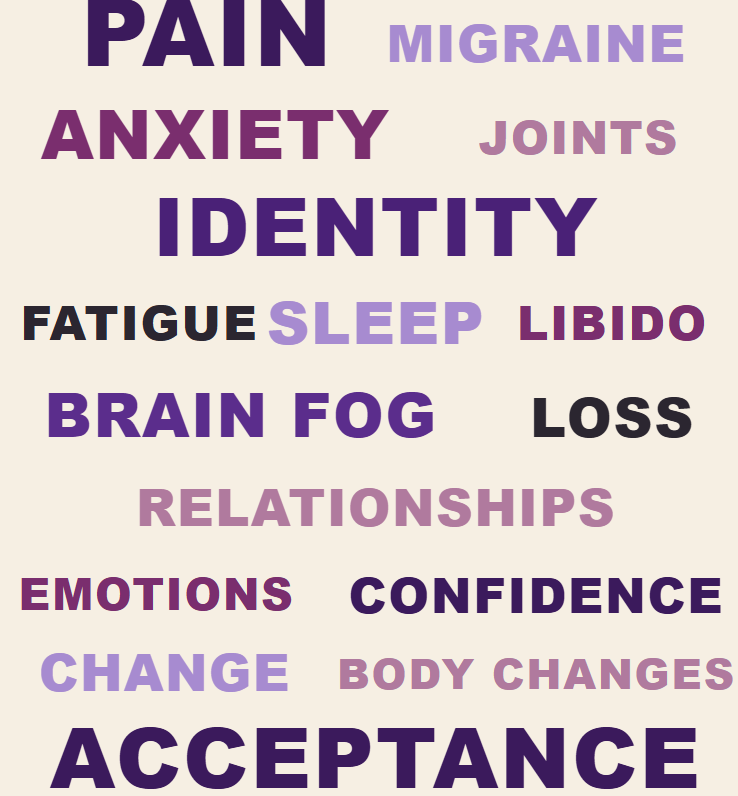
That is perhaps the simplest way to understand why stories like this matter. Behind a diagnosis, a urine sample, a hospital admission, a dismissive experience or a prescription is a person who is experiencing something in their body, when that experience is repeated over the years. It can affect far more than physical health; it can affect confidence, relationships, plans, work, sleep, nutrition, emotional well-being, the ability to exercise, the confidence that someone will help when you need them to and, in particular, the ability to trust your own body.
Gabriella’s story, her words
There is no neat ending to this story; it remains ongoing, and there is not one moment when everything is solved. Instead, there is a woman who has spent decades learning about her own body, seeking answers, experiencing periods of severe pain and finding ways to keep living in between them. Gabriella’s story reminds us that chronic pain does not always look the way we expect it to; sometimes it is dramatic and visible, whilst on other occasions it is a woman quietly carrying on with her day while pain sits somewhere in the background. Also, it can be the relief of waking up and realising: “I've not got any pain!” or simply the knowledge that the pain is there, waiting.
“Pain becomes normal.”
However, perhaps the most important words she leaves us with are these:
“This needs to be heard.”
At Plymouth Menopause Network, we believe women's experiences deserve to be heard, taken seriously and talked about without embarrassment. If you are experiencing new, persistent, recurrent or severe urinary, vaginal, pelvic or abdominal symptoms during perimenopause or menopause, speak to a healthcare professional. Menopause may be part of the picture, but it should not automatically be assumed to be the explanation. Your symptoms are worth discussing, and your questions are worth asking. Experiences matter, in some cases, as in this story, seeking a private, knowledgeable and reassuring care can be part of the answer.
This story has been shared with permission. It is based on a woman's personal experience and has been edited for clarity and length while retaining her own words wherever possible. Her experience does not represent every woman's experience of urinary or urogenital symptoms, chronic pain or menopause. Name changed to protect privacy.
The information about menopause and genitourinary symptoms is provided for general information and is not a substitute for individual medical advice.
References
NHS (2026). Symptoms of menopause and perimenopause.
https://www.nhs.uk/conditions/menopause-and-perimenopause/symptoms/
Angelou K, Grigoriadis T, Diakosavvas M, Zacharakis D, Athanasiou S. (2020). The Genitourinary Syndrome of Menopause: An Overview of the Recent Data. Cureus. 12(4):e7586. doi: 10.7759/cureus.7586. PMID: 32399320; PMCID: PMC7212735.
NICE. (2018). Urinary tract infection (recurrent): antimicrobial prescribing. https://www.nice.org.uk/guidance/ng112/chapter/recommendations